

“Knowing ball” is a Gen Z slang that’s defined as being “knowledgeable about a specific topic” by the Urban Dictionary, and is often attributed to sports knowledge. Many students at CHS bet on sports due to their belief that they “know ball.”
“I see a lot of my friends sports betting,” senior Keshav Rawat said. “At the Super Bowl, people were putting down a lot of parlays. A lot of my friends lost, and they lost a good amount of money, but some of them did win.”
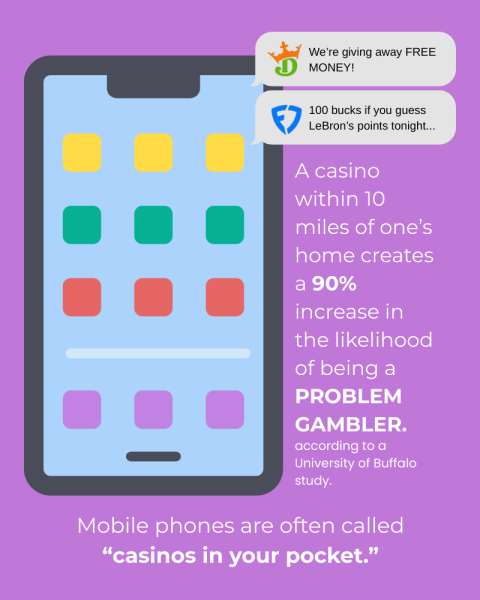
This reflects a nationwide trend; 12% of teen boys participate in sports-related gambling, even though it’s illegal to do so under the age of 21 in most states, including Virginia. The increase is in large part due to the Supreme Court of the United State’s 2018 decision to legalize sports betting, overturning a 1992 law that banned it in most states. This has led to easier access to sports betting in the form of sportsbooking apps such as DraftKings and FanDuel.
“As high school kids, we didn’t talk about betting,” math teacher John King, who was in high school from 1970 to 1974, said. “But people would bet among themselves, like, ‘The Packers are going to beat the Bears this weekend.’ But again, that was not a big fraction of people. Betting just wasn’t a thing.”
The rise of sports betting from people under 21 is in part due to lax security from sportsbooking apps. Even though it is illegal for under-21s to access these apps, younger users are often able to get around age verifications.
“It’s probably way easier than it should be,” science teacher Ian Goozh said. “You basically just need an email address, a name and maybe a tiny bit of other personal info. Just in my conversations with some students in recent years, I do know some of them might use an older brother’s account or their dad’s account. I wouldn’t be surprised at all if there’s a large number of people under 21 who have their own accounts who probably shouldn’t.”
Just like regular gambling, sports betting stimulates the brain’s reward system. However, unlike regular gambling, sports betting can intensify an already developed interest.
“It just kind of gives you some extra enjoyment and excitement and incentive during the game,” Goozh said. “If I’m just sitting around watching a football game on a Sunday afternoon, and it’s a game where I don’t even care about the teams — it just kind of gives you that extra interest and enthusiasm when you’re watching a game.”
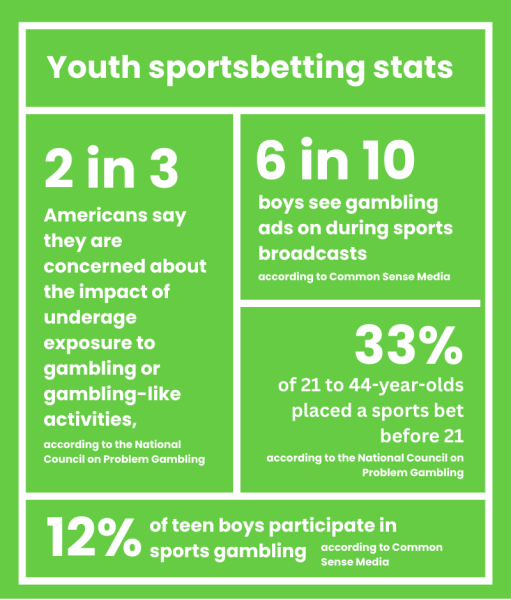
Men under the age of 25 are especially prone to problem gambling. Often, whilst sports betting, their belief that they “know ball” convinces them that they can beat the system and continue to bet — yet in one survey, only 3% of sports bettors reported profits over 6 months.
“The illusion is that you do have some control, and hence you get sucked in,” King said. “You really have no control, because the people that make money, they’re in it for the long haul, and they know the expected values. They care about you just coming back again and again and again and losing your 20 bucks, or your 100 bucks, or your 50 bucks or whatever it is.”
Research has shown that a gambling addiction can lead to increased financial stress, strained relationships and mental illness. According to the National Library of Medicine, those who start gambling before 18 are 50% more likely to develop a gambling problem.
“They’re after you, they’re after the young,” King said. “They want lifetime addicted people and it’s really not good. I don’t see any social benefit to it. Of course, it’s a short term thrill of winning, but, in the long term, you’re gonna lose, and the more you play, the more you’re gonna lose.”