As the nationwide redistricting debate comes to Virginia on April 21’s special election, voters will face the question on whether lawmakers should be allowed to temporarily redraw Virginia’s congressional map. A total of 168 schools will be closed on April 21 to serve as polling locations, according to FCPS.
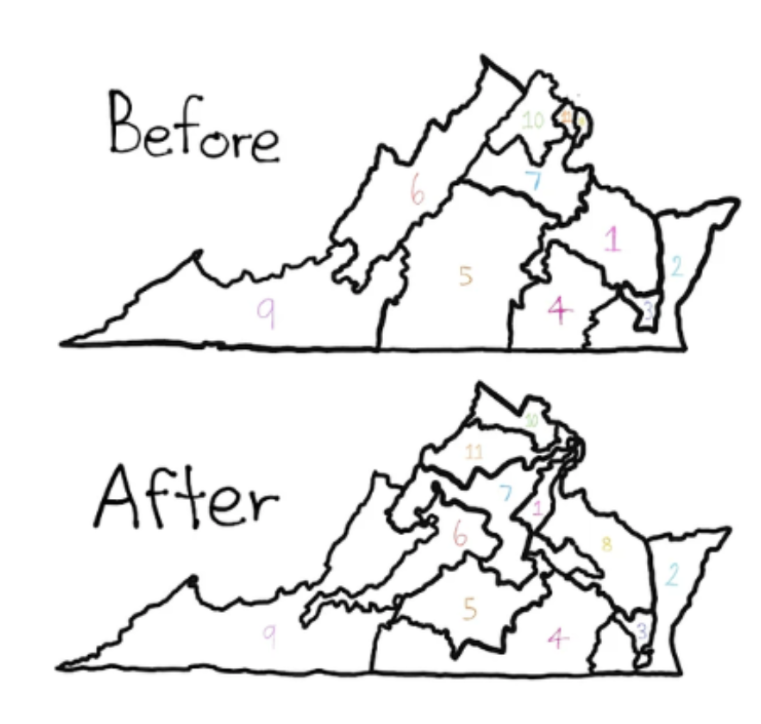
If passed, the amendment would allow the Virginia General Assembly to temporarily redraw Virginia’s congressional boundaries ahead of the 2026 midterms in response to the Republican-led redistricting attempts in other states. Normally, district maps are only redrawn after the Census, which would be in 2031.
The passing of this redistricting amendment could shift the state’s balance of power in the House of Representatives, redrawing the boundaries to potentially give Democrats an advantage in the House of Representatives. However, this is a form of gerrymandering, often considered morally unethical, according to a study by Gianna Sara, A PhD candidate at King’s College London.
“Gerrymandering is when congressional districts are cut up in a way to favor a particular political party,” history teacher Daniel Ashley said. “It is a way to ensure that only their candidates will be elected.”
According to Democracy Docket, the manipulation of district lines is not a new practice, but it is one that has become increasingly evident in states throughout the country such as Texas, North Carolina and Missouri as a way to give Republicans an advantage in the November midterm elections. These gerrymandered state maps often have abnormally-shaped districts and an unusually high partisan bias in seat allocation, according to the Brennan Center for Justice.
“[The] map is not drawn based on sensible boundaries,” Ashley said. “When you look at a gerrymandered map, it looks like what used to be called the Rorschach test, like somebody threw ink on a page. It doesn’t make any sense. A city can be broken up into five congressional districts when it should actually only be one.”
According to the Fair Elections Center, gerrymandering is best understood through two lenses: “cracking,” which splits communities across multiple districts, and “packing,” which concentrates voters into one district. However, this manipulation of electoral districts can have a large, often negative effect on political representation.
“To me, the whole idea of gerrymandering is unfair in general,” senior Advik Sood said. “It’s really to just advance the party and what [it] wants. I understand why Democrats want to push back, because this happened in Texas and Missouri, I know Florida wants to do it as well. But I think this is adding fuel to the fire. I don’t think I would ever vote yes.”
Sood explained that although casting a ballot for either side felt like a lose-lose situation, he will likely vote against the amendment despite reservations of voting alongside Republicans who would support gerrymandering efforts if it benefited them. He believes the passing of the amendment could further escalate a chain of redistricting efforts across other states, worsening the problem. On the other hand, senior Yasmin Engelen will be voting “yes” in the election.
“I voted yes because the current administration is rigging elections throughout the country,” Engelen said. “[This] is biased and unfair, so Virginia and other states that are holding elections like we are doing, is the best way to combat the threats to fair elections.”
According to the American Constitution Society, America’s redistricting battle began when Donald Trump urged Texas Republicans to redraw their state’s congressional map, capitalizing on the party’s razor-thin majority in the House. In response, Democratic-led states such as California have launched their own redistricting efforts in an effort to counteract the Republican power grab.
“It could set a new norm, unfortunately,” government teacher Ryan Childress said. “It seems we’ve taken gerrymandering on a local or state level and turned it to a national level. One district might be redrawn within the state to sort of balance things, [but] now it’s just at a national level and whole states are being redrawn rather than districts.”
According to the Virginia Department of Elections, this national shift prompted Virginia’s Democratic-majority legislature to temporarily bypass the state’s 2021 bipartisan redistricting commission. The commission was created by a 2020 amendment to draw electoral maps, taking out partisan influence from the mapmaking process, according to The Richmond Public Interest Law Review.
“It’s bad that they did this good thing, and now they’re undoing it,” Ashley said. “I also feel that for the country, we are having an existential crisis, meaning our democracy is under threat. While gerrymandering is anti-democratic, a president who thinks he’s God is anti-democratic too.”
If the amendment passes, Virginia could shift from its 6-5 Democratic majority in the House of Representatives to a 10-1 Democratic majority. However, if redistricting efforts fail, Republicans could maintain their advantageous foothold gained through redistricting efforts in Texas, Missouri and North Carolina, which could open up 7 congressional seats for Republicans, according to Democracy Docket. 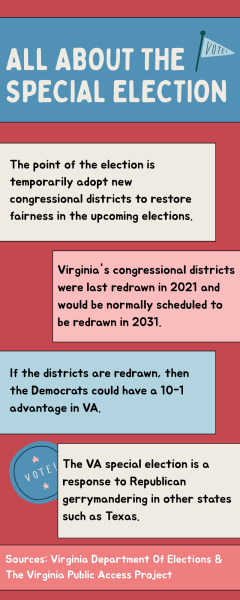
“I’m not looking forward to the conclusion, because I don’t think it’s going to help anyone,” Sood said. “On one hand, you vote yes, and just make the problem worse, because other states are following suit. At the same time, I find it really hypocritical for [Republicans] to campaign that this is totally unfair when they’ve done it as well.”
According to Virginia’s Law Portal, with Virginia’s voting age set at 18, many high school seniors are eligible to vote in the special election. Childress argues that all students, especially those who are passionate about the issue and want to get involved, should vote when they can.
“It’s not what you vote for,” Childress said. “It’s if you vote at all. If you agree with it, you should go and vote yes, if you disagree with it, you should definitely go out and vote no.”
Since 2016, young adults have accounted for around half of the voting population, and are often considered the most diverse, according to the David Eccles School for Business. Moreover, it is important that they vote in elections as a way to express their rights, since their generation will be the most affected by the long-term consequences of political decisions made today, according to the Sandy Hook Promise.
“Voting is not only our responsibility as citizens, but also the best way to make sure our voices are heard,” Engelen said. “We are able to be involved politically through protests, donations and voting. Voting is so simple and if we want to make a change it is important that we all vote because every vote makes a difference.”