
With the appointment of Abigail Spanberger as governor, Virginia has seen multiple changes regarding its gun laws. Much of this major legislation was approved in April and May 2026, with the majority of the legislation itself going into effect on July 1, 2026.
Virginia’s new gun laws address many aspects of firearm ownership, with the most significant measures being House Bill 217 and Senate Bill 749. These bills ban the sale of some semi-automatic firearms, as well as firearms with a magazine capable of holding more than 15 rounds (bullets). The recent bills have also included major changes as to how weapons can be carried. According to U.S. Concealed Carry, open carry of a gun that is not a “defined assault firearm,” is still legal in Virginia for anyone who can legally possess a firearm, while concealed carry—the practice of carrying a hidden weapon—is legal with a permit.
The minimum age to purchase handguns and certain types of semi-automatic firearms has also been raised for individuals not in military or law enforcement training. Furthermore, this legislation also bans the sale of ghost guns and expands the definition of assault firearms to include semi-automatic center-fire rifles with detachable magazines, folding stocks, pistol grips or threaded barrels. As a result of these laws, Virginia is experiencing a newfound surge in gun purchasing.
New restrictions on firearms and carry laws
The new law restricts high-capacity ammunition devices by prohibiting the sale, transfer, or manufacture of any magazine capable of holding more than 15 rounds. Spanberger has also removed the word “fixed” from the bill’s updated definition of banned assault firearms, which significantly expanded the types of semi-automatics that are now banned under the new legislation. Violating the sale, manufacturing and purchase bans is classified as a Class 1 misdemeanor, which is punishable by up to one year of jail and a fine of $2,500, according to the state’s Legislative Information System.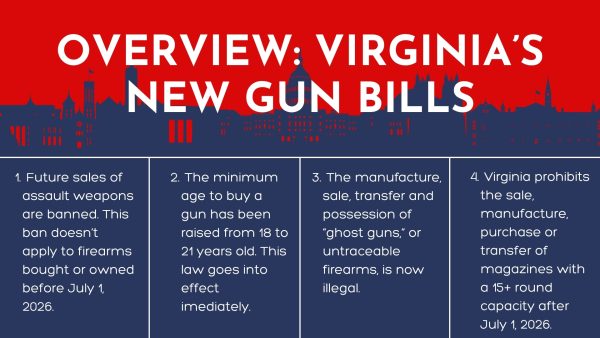
“These are relatively superficial restrictions,” social studies teacher Matthew Miles said. “They’re not getting rid of existing guns [so] I think most moderate Americans might not view these as too extreme. Most guns are still going to be legal however, such as the ones that circumvent existing laws.”
Regardless of these statewide assault weapon bans, the sale, purchase and ownership of handguns is not banned in Virginia for eligible adults. The broader definition of “assault firearms” also excludes .22-caliber rimfire weapons due to VA Code 18.2-299, which states that weapons with a caliber of less that 0.225 are excluded from the wider ban, which ensures that standard .22 target rifles are not classified as illegal short-barreled weapons.
Spanberger has also signed legislation banning the public carry and transport of prohibited firearms on roads, public streets, sidewalks and public parks. These amendments also removed previous legal exemptions that permitted Concealed Handgun Permit (CHP) holders to carry these weapons in public spaces. Furthermore, House Bill 626 bars the carrying of weapons on public college and university campuses, allowing carry only for law enforcement, ROTC and military personnel.
Additionally, according to US Concealed Carry, the legal age to purchase handguns and certain semi-automatic rifles was raised from 18 to 21. It was an emergency provision that went into effect immediately upon signing.
The rise of ghost guns
One of the primary concerns that encouraged the creation of the new legislation was the recent surge of ghost gun recoveries and sales in Virginia. Ghost guns are individually assembled firearms that lack a serial number, making them untraceable by law enforcement and easily obtainable without a background check, according to Brady United.
Enacted in April 2026, House Bill 40 and Senate Bill 323 both ban the manufacture, sale, possession, and transfer of firearms that lack valid, state or federally recognized serial numbers. The law also updates detection standards to ban firearms and components that cannot pass through airport, school or government security machines, according to Governor of Virginia.
“It’s a definite loophole,” Miles said. “If you’re the owner of a gun and you need a new trigger, pin, or muzzle, a replacement part could be purchased. But if you’re selling the whole gun with instructions on how to assemble it, it gets complicated. What is legally an assault rifle is something that is debated and differs from state to state. Fully automatic guns have been illegal for a long time, but if you swap out a couple parts, you can make your semi-automatic gun fully automatic fairly easily.”
According to the National Police Foundation, ghost guns can be produced in a variety of ways, with the majority being produced by “80% kits,” an unassembled set of firearm components, or 3D printing, which allows for the fabrication of firearm components from digital files using different types of filament. Moreover, they can be assembled in large quantities in a short amount of time, creating opportunities for gun trafficking. Due to the lack of identifiers commonly used during the investigative process, ghost guns can often hinder gun-related investigations.
“Ghost guns are a problem for public safety,” Tramel said. “3D printing makes it possible for individuals to make guns at home, but I feel like some of that is more hysteria driven. They’re trying to address an issue in a way that doesn’t address the issue, because a lot of these guns are already owned or have been sold.”
Potential federal government response
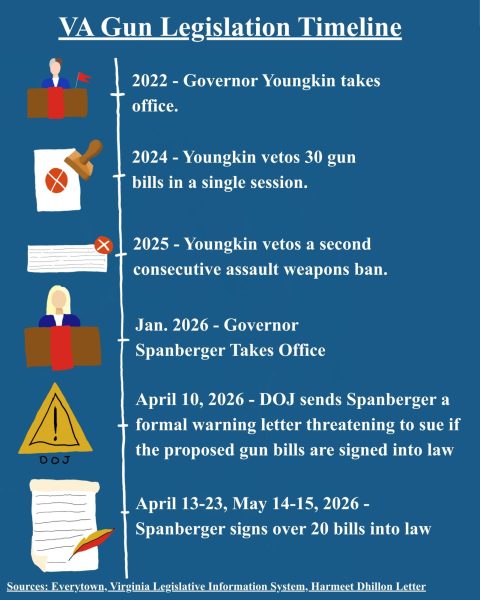
Following Virginia’s new gun legislation, the Federal Department of Justice has threatened to sue the state for violating Second Amendment rights. However, this is not the first time that the federal government has interfered with state legislation.
Social studies teacher Andrew Tramel notes that there have been many similar cases in the past, such as McDonald v. City of Chicago (2010). According to Oyez, in this case, a divided Supreme Court ruled that the Second Amendment right to own a firearm for self-defense applies to local and state governments, meaning that states cannot completely ban guns.
 However, by incorporating the second amendment, the Supreme Court had to overrule and sidestep historical cases that had established that the Bill of Rights does not apply to state and local gun regulations. According to the Legal Information Institute, Miller v. Texas (1894) was a U.S. Supreme Court case where the Court unanimously ruled that the Second Amendment and Fourth Amendment—which prohibits the conduction of unreasonable searches and seizures—did not apply to federal and local governments prior to the 20th century incorporation doctrine.
“There’ve been many Supreme Court cases in which you’ve had individual states attempt to ban weapons,” Tramel said. “The Bill of Rights says that all these things are guaranteed as Americans, and there [are] multiple examples in which the Federal government intervenes when states try to challenge individual liberties, and guns [are] just one of those.”
Public response to gun violence and policy
Currently, Virginia is experiencing a massive increase in gun purchasing ahead of July 1, which is when the new firearms restrictions are set to take effect. Virginia background checks topped 75,000 in May 2026, more than double the 35,571 checks recorded in May 2025 according to Rifle Configurator. This surge can be primarily attributed to panic-buying ahead of the newly signed legislation, which will take effect on July 1.
The purchase of these guns is also possible because of the “grandfather clause,” a provision in a law or contract that allows individuals or entities to continue an existing activity despite new regulations that would otherwise prohibit it, according to US Legal. Because the legislation only outlaws the future sale, import, and transfer of “assault firearms” and magazines holding more than 15 rounds, weapons that are purchased before July 1 are “grandfathered” in, allowing current owners to keep them.
According to the Sandy Hook Promise, Virginia has had at least 73 mass shootings since 2020, and guns are the number one leading cause of death of children, with the state having the 29th highest firearm death rate in the U.S. Fatal and mass shootings such as the 2007 Virginia Tech Massacre have raised calls for stricter gun legislation, yet these demands were not met for many years.
“We’re always reactionary,” Tramel said. “Whenever an event happens, politicians from both sides try to get their soundbite in. But traditionally, legislation takes a long time to enact change, and it really frustrates people. I lived through the Virginia Tech shooting because I had friends in Virginia Tech at the time. There was a lot of push for gun regulation at that time, but nothing actually happened.”
However, more recent events such as the Old Dominion University shooting on March 12, 2026 have further inspired the creation of this legislation. According to the Pew Research Center, since 2021, there has been a major rise in public support for stricter gun laws, with 58% of Americans saying that stricter gun laws are a necessity. Public shootings are historically the most powerful catalysts for major gun legislations, with assault weapon and large-capacity magazine bans being some of the best ways for policy makers to prevent public shootings, according to a study published in the Journal of Medical Internet Research Public Health and Surveillance.
“That’s some very good motivation for this legislation,” junior David Kuperman said. “I think Virginia has definitely become more Democratic since Trump won again. Democrats are more pro-gun control and Republicans are anti-gun control, but I still don’t really think that taking these guns away would be the best solution when it comes to gun violence.”
Kurperman believes banning certain firearms does not entirely solve the widespread problem of gun violence, despite the changes this legislation has brought to Virginia; rather he believes that mental health and other factors play a large role in its increase. However, only around 5% of mass shootings have any relation to severe mental illness, with about 23% of mass shootings being associated with substance use, and 25% being linked to non-psychotic psychiatric illnesses such as clinical depression, according to the Columbia University Department of Psychiatry.
Many Americans remain polarized over gun rights, with half of U.S. adults arguing that firearms are a crucial tool for self defense, while the other half argues for stricter control, according to the University of Nevada. Ultimately, both Miles and Tramel agree that despite the new Virginia legislation having its benefits, there is still a large possibility that it will not lead to a noticeable decrease of gun violence.
“I don’t really see it changing much,” Tramel said. “Changing the purchasing age from 18 to 21 is a good thing, simply because you’re reducing the access to guns, but criminals are still going to possess guns and take action. Individuals who are motivated enough are going to do things to try to be successful at their heinous acts and that’s kind of the reality of the situation in society.”