Skip to Content
Categories:

FCPS tackles sustainability

Images used from Canva under their Content License Agreement and fcps.edu.
Ariya Lee
Introduction

As the planet experiences its warmest years on record due to human-caused global warming according to the World Meteorological Organization, sustainability remains a challenge for both schools and governments. 

“The effects of climate change and pollution are real and will continue to have major consequences, including higher energy costs, more frequent and destructive natural disasters and public health problems,” FCPS School Board member Melanie Meren said.

FCPS accepted recommendations from the Fairfax County Joint Environmental Taskforce (JET) in 2021 that included sustainability targets for the county to achieve zero waste by 2030, 50% emissions reduction by 2030, electric student transportation by 2035 and carbon neutrality by 2040. These goals aim to address FCPS’s impact as the ninth-largest U.S. school district on global warming and climate change, which is causing rising sea levels, water scarcity and intensified droughts across the world.

Solar panel installation begins at Olde Creek Elementary School, which was connected to the grid in October.
Solar panels on schools

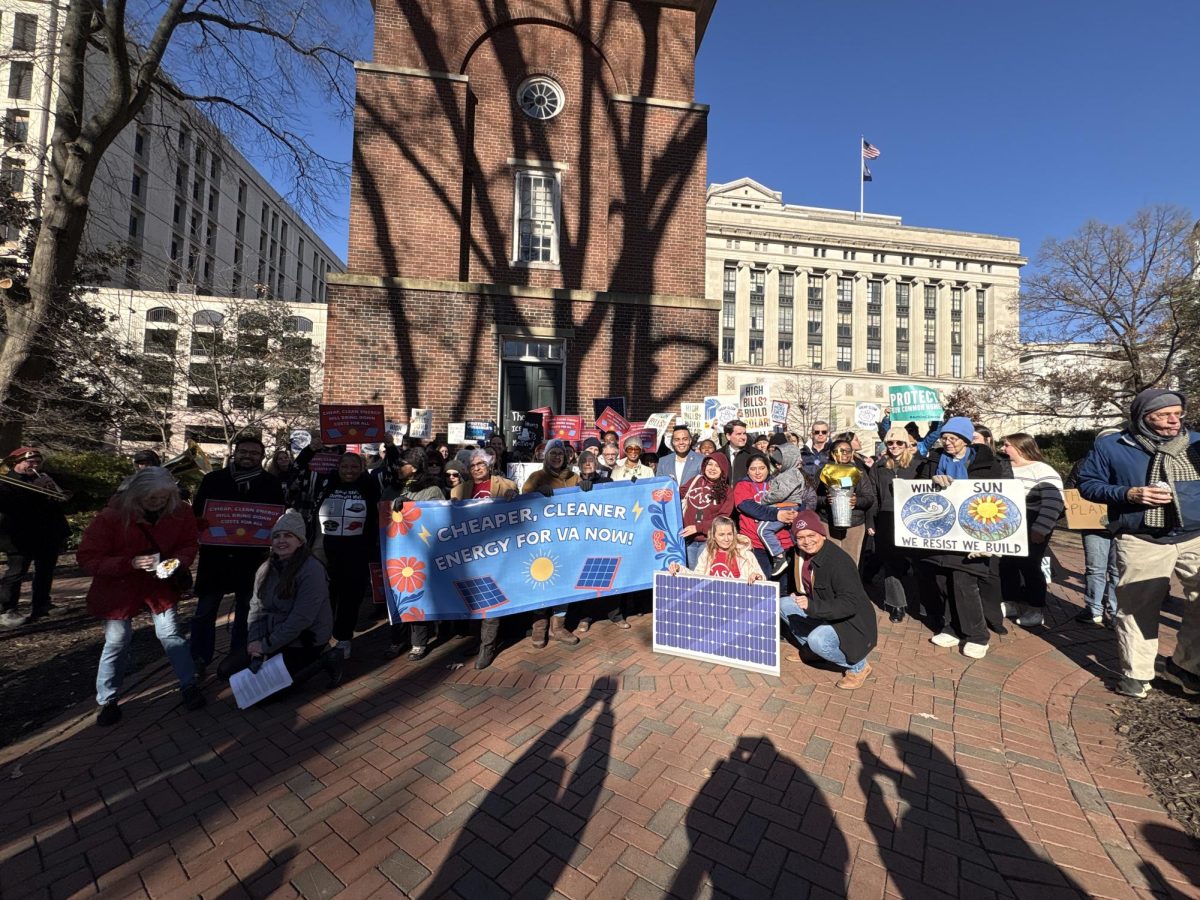
Amid FCPS’s efforts to install solar panels on schools, the county faces new obstacles after a Feb. 5 decision by the Virginia State Corporation Commission (SCC).

The decision upholds the regulations Dominion Energy established in 2023 for customers generating over 250 kW of their own energy through on-site renewable sources called distributed energy resources (DERs). Dominion’s regulations require the installation of direct transfer trip systems, infrastructure that automatically disconnects DERs, such as solar projects, from the grid in the event of a disruption.  

“They changed some rules and made it so that solar projects bigger than 250 kW, which most schools would be, were subject to extra fees to upgrade their transmission lines and infrastructure,” volunteer with climate justice nonprofit Mothers Out Front Bobby Monacella said. “Those fees could be up to $1 million, so it just made so many of those bigger projects unworkable.” 

In response, multiple solar companies and advocacy groups under the Virginia Distributed Solar Alliance (VA-DSA) argued that these requirements were arbitrary and unnecessarily expensive, especially for schools. These groups petitioned the SCC to remove the requirements for small-to-mid-sized projects. Yet, on Feb. 5, the commission ruled in Dominion’s favor.

The fiber optic requirement allows for a very rapid disconnect of the solar system from the grid,” volunteer with environmental grassroots organization Sierra Club and VA-DSA member Susan Stillman said. “We agree that there should be devices that provide that sort of shut off, but there [are] other technologies that are less expensive that are just as effective.” 

In 2015, Stillman began working with three FCPS high schoolers to lobby the school board to implement a county solar energy program. Eventually, the school board approved the administration of Power Purchase Agreement (PPA) contracts, an arrangement where a solar company installs and owns panels on an FCPS roof and FCPS buys the electricity from the solar vendor. 

“FCPS is just providing the rooftop and what the developer offers is a cheaper rate for electricity than FCPS would get from the utility,” Monacella said. “So they save money in that way, but they don’t have to pay anything up front to have the solar installed.”

While the Dominion SCC ruling was still pending, FCPS approved initiating PPA contracts with the local solar company Sun Tribe for 34 schools small enough to install solar arrays under 250 kW. Currently, Olde Creek Elementary School is the only approved school of the 34 with solar panels, which were installed last year. 

In November, volunteer with Citizens’ Climate Lobby Sarah Karush started the Fairfax Solar Schools Campaign. The campaign encourages students to spread the word about solar power to their school communities and send letters to FCPS leadership to approve more solar projects before federal tax credits expire due to the One Big Beautiful Bill Act. Signed into law on July 4 by President Donald Trump, the act terminates the 30% commercial tax credit for solar and wind facilities that begin construction after July 2026 or complete construction after 2027. 

“The problem is we do not have time to wait, because federal tax credits are being phased out early,” Karush said. “We’re asking everybody who hears our message to take action by sending letters to their school board members and to Dr. Reid, and the message of these emails is basically, ‘Great job, 34 schools, keep going, do more.’”

According to their website, FCPS spends over $42 million on electricity, oil, gas and water annually. The estimated energy cost savings per school PPA contract range from $100,000 for smaller elementary and middle schools to over $2 million for Herndon High School. 

“Climate change is happening; until we start reducing our reliance on fossil fuels, we will see worse and worse consequences,” Karush said. “But even if you don’t care about climate change, you should want your schools to operate as efficiently as possible, so that more money can be spent on teachers and classroom resources. Why should we be paying Dominion lots of money to keep the lights on, when we could be generating that energy ourselves on the roof?”

Solar panel installation begins at Olde Creek Elementary School, which was connected to the grid in October. (Photo used with permission of Bobby Monacella)
Recycling in schools

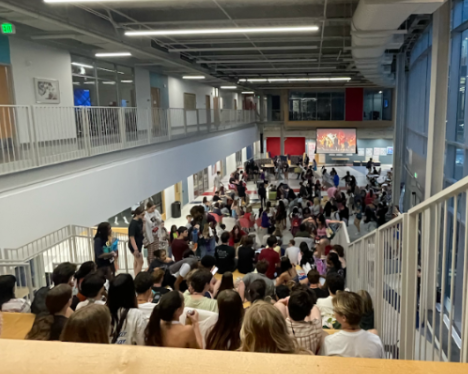
“Okay, Chargers! That’s the end of lunch!” Bustling to get out of the cafeteria, students throw their trash in the bins, blue or not, before rushing out. As a result, blue bins designated for recycling are filled to the brim with not only plastic and empty milk cartons, but also food waste. 

Through Get2Green, an FCPS environmental protection program that promotes sustainability through awareness campaigns and data collection, the contents of trash and recycling bins are weighed before being dumped into garbage trucks. This data is organized in the FCPS Recycling Data Dashboard, which indicates that 16.46% of CHS’s discarded materials are sent for recycling. However, it remains unclear whether the contents of the recycling bins are actually recyclable.

“The truth is that our custodial team works really hard, [but] we’re often lacking [custodial] positions,” Get2Green senior manager Chrissy Brownson said. “We can’t fill the jobs fast enough, and they don’t have time as part of their job to sort trash and recycling. If they go to pick up recycling in your classroom and somebody has thrown tissues in there, they don’t have to pick out the tissues. They’re just going to treat that whole thing as trash.”

With the shortage of custodians making it difficult to ensure the proper separation of recycling and trash, Get2Green is calling upon students to take responsibility in protecting our planet by putting up posters and putting together awareness campaigns. Student involvement has resulted in 44 FCPS schools receiving the National Wildlife Federation Green Flag Award for strong, stable sustainability efforts led by both staff and students in 2025. 

“We’re finding a lot of success [in] having the students actually monitor and teach each other and hold each other accountable,” Brownson said. “It’s [a] partnership among everybody at the school to meet the goals.”

EV buses

In line with its goal of carbon neutral student transportation, FCPS celebrated the addition of 17 electric school buses to its fleet on Sept. 22, bringing the total number of its operating EV buses to 48. Currently, FCPS is in a budget deficit; the approved budget required $121 million in reductions, which was accomplished in part by cutting funding for electric buses. 

“A lot of the sustainability goals require investment, like electric buses,” Karush said. “They had some [national] grants for electric buses that were lost, so it’s understandable that FCPS, when with a budget crunch, would need to pull back from those.” 

All but three of the 48 school buses in operation were funded by grants, as the cost of an electric school bus averages around $400,000, significantly higher than the upfront cost of a diesel bus, according to the U.S. Department of Energy.

“Money is the primary factor in tackling environmental issues,” Meren said. “Electric buses have a low carbon footprint and save energy and money over time, but it takes a lot of funding up front to purchase them. At this moment when the federal government has withdrawn support for public education, our schools rely on limited resources from the state government. The status quo does not permit us to act with the urgency needed to meet the moment.” 

Student advocacy
Senior Sam Tummala presents her “From Waste to Worth” research project at the Regeneron International Science and Engineering Fair. (Photo used with permission of Alina Albeik)

Students can take action through various programs and organizations both inside and outside of school, depending on how they want to contribute. Whether that be through scientific research or through hands-on environmental stewardship with the Student Conservation Association (SCA), students can join efforts to nurture and protect their environment. 

Inside the school, students can take action through Get2Green and environmental science research projects. The program focuses on climate change awareness and student action; for example, Get2Green develops ideas and plans to reduce plastic use in schools, including cafeterias.

“With Get2Green, we work on shifting [plastic usage] culture and suggesting to schools that they buy big reusable jugs or suggest that students bring reusable water bottles to school,” Get2Green senior manager Ali Culhane said. “We do campaigns that way, kind of grassroots, and that has made a difference in the amount of single-use plastics [used in schools].” 

At CHS, Get2Green is called Eco-Chargers. Currently, they are working on trying to send some members to different classrooms to do recycling audits and ensure the correct separation of recyclable content. To join efforts to promote sustainability in CHS, reach out to science teachers Jennifer Garrod-Smith and Neelam Yadav. 

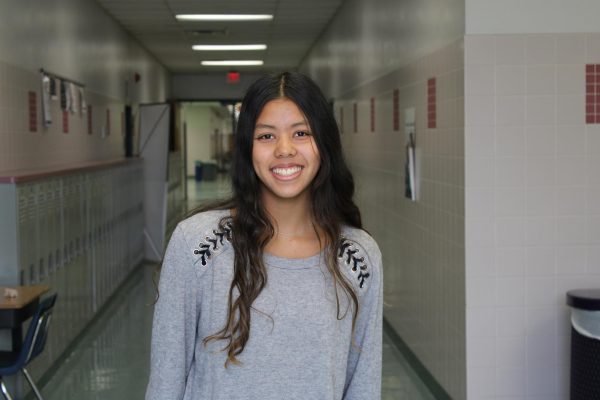
Beyond joining the Eco-Chargers, students like senior Sam Tummala lead sustainability efforts through environmental research. Through her research project on an alternative to styrofoam that could sustainably be disposed of as fertilizer, Tummala was recently announced as one of nine FCPS students among the nation’s top 300 teen scientists by the Society of Science through the Regeneron Science Talent Search.

“This research actually started out as a science fair project,” Tummala said. “I had seen some of my family microwave day-old rice instead of eating fresh rice, and as I looked into why that was, I learned about the starch property that makes re-heated rice harder to digest, and therefore better for health.”

Even without access to a formal laboratory or major funding, Tummala developed an innovative method to repurpose wasted starch, such as leftover rice or potatoes, originally intended for consumption. According to the Environmental Protection Agency, this approach helps reduce methane emissions produced when food decomposes in landfills, as well as pollution from the production of single-use plastics and chemical fertilizers. 

While research and in-school initiatives focus on changing systems and habits, hands-on environmental work allows students to see the direct impact of their efforts. Outside of school, students can interact with their environment through hands-on volunteering with SCA, a national environmental nonprofit organization that provides paid opportunities for students year-round to promote environmental stewardship. 

“We’re going to have a high school summer crew that will be working in Rock Creek Park this summer, maintaining trails [and] removing [invasive plants],” SCA DC Program Director Katy Swiere said. “You’re getting paid, but also you’re giving back to the environment: you’re improving it for visitors, you’re improving it for wildlife, you’re making things more sustainable and you’re spending time outside.”

Beyond summer opportunities, SCA hosts a few volunteering events throughout the year. For example, on Jan. 19, SCA hosted a cleanup in Anacostia Park for Martin Luther King Jr. Day. More information on paid jobs and volunteering opportunities with SCA is available on thesca.org

“While [student] efforts can often feel marginal compared to what we see professionals do, seemingly simple changes do actually go a long way,” Tummala said.

Donate to The Purple Tide
$370
$600
Contributed
Our Goal

Your donation will support the student journalists of Chantilly High School. Your contribution will allow us to cover our printing and annual website hosting costs.
More to Discover
About the Contributors
Ariya Lee
Ariya Lee, News Editor
Ariya is a junior in her second year with The Purple Tide. Other than journalism, she is interested in climate policy and enjoys reading and traveling. She is a member of Chantilly’s girls swim team, Students for Environmental Advocacy club and Writing Center. She is excited to write for The Purple Tide as the News Editor this year!
Claire Baek
Claire Baek, Editor-in-chief
Claire Baek is a senior in her fourth year with The Purple Tide. While having a passion for both print and broadcast journalism, Claire is also part of Model UN and the Senior Class Board at school. Outside of school, she spends most of her time doing rhythmic gymnastics and creating stories about her community.
Donate to The Purple Tide
$370
$600
Contributed
Our Goal