
Patients flood in, crash carts are brought out and hospital staff scramble to treat everyone. This is just part of the plot for medical shows. According to TVinsider, staple television involves medical dramas. In the top 11 are: “The Pitt,” “House,” “ER” and “Grey’s Anatomy.”
Medical TV has its unethical and unprofessional depictions of medicine which can mislead the audience, but it can also provide insights into diseases and conditions. The portrayal of medical care and practices often deviates from reality and can create unrealistic expectations, according to the National Library of Medicine. One misconception that is evident in medical shows are the relationships between the staff. In “Grey’s Anatomy,” the doctors get into romantic relationships with one another and switch partners regularly, putting an overemphasis on the drama, rather than real behind the scenes work climate.
“In terms of the relationships, they’re not accurate,” Medical Assistant 2 teacher Cindy Dowd said. “They gave this view that in the hospital there are residents that are having affairs with nurses and things like that; we don’t have time for that in real life. It also gives them a false idea about what it’s really like out there– It’s brutal. It’s not rainbows and butterflies, it is really hard work.”
Despite the inaccuracy in relationships, medical shows can be accurate when referring to the medical terminology actors use. Medical TV shows don’t try to confuse their viewers by making up fake names of diseases, medications or procedures because they are used by real healthcare professionals, according to Cleveland Clinic. The use of accurate terminology is also beneficial for students, especially those in health related classes, to learn new abbreviations and terms. The show “ER” uses many terms such as bronchoscopy, cordotomy and DNR that accurately represent real-life use of these terms in action.
“What helps students is when they watch a show like ‘The Pitt’ or even ‘Grey’s Anatomy,’ and can pull out medical terminology that they learned in class,” Dowd said. “They can actually understand what they are talking about.”
However, these series have an influence that extends viewers’ perceptions of healthcare and medical professions. This underscores the need for accurate and responsible portrayal of health issues in the media, according to the National Library of Medicine. In the show “House M.D.,” the main character, House, forces entry into a patient’s home and administers a drug without patient consent which, in real life, would lead to lawsuits and severe disciplinary action against him.
“I feel like when I was watching them I will have to constantly stop because it’s not true,” health science teacher Jennifer Callahan said. “It’s entertaining and it’s fun to see them figure out the diseases, but who is going to send a group to a person’s home?”
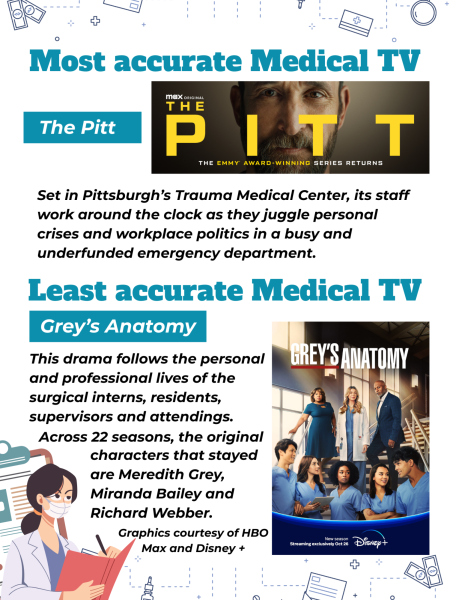
Out of all the medical dramas, the most accurate noted by the interviewees and media is “The Pitt.” According to the Clinical Advisor, the medical cases in “The Pitt” are presented accurately and address many challenging social issues including: organ donation, violent patients, Post-Traumatic Stress Disorder (PTSD), addiction, miscarriage and burnout.
“‘The Pitt’ actually deals with how the administration of the hospital is focused on Press Ganey scores, which are the patient satisfaction scores, and the care that is given,” Dowd said. “The other hospital shows don’t even bring that up.”
On the other hand, the least accurate medical drama stated by the interviewees was “Grey’s Anatomy.” According to Newsbytes, there is a lack of professional boundaries with a thin line that separates the doctors from their professional and personal lives. In reality, there are strict policies on workplace behavior in hospitals to maintain professionalism and ensure the patient’s safety.
“As much as people like it, it can get really convoluted,” senior Isabella Caltagirone, a student in the Exploring the Language of Medicine class, said. “The biggest misconception is the way that you’re talking to patients; be clear with them and honest. You’re not yelling across the room. It makes it seem like it’s a lot less of a professional environment than it really is.”