

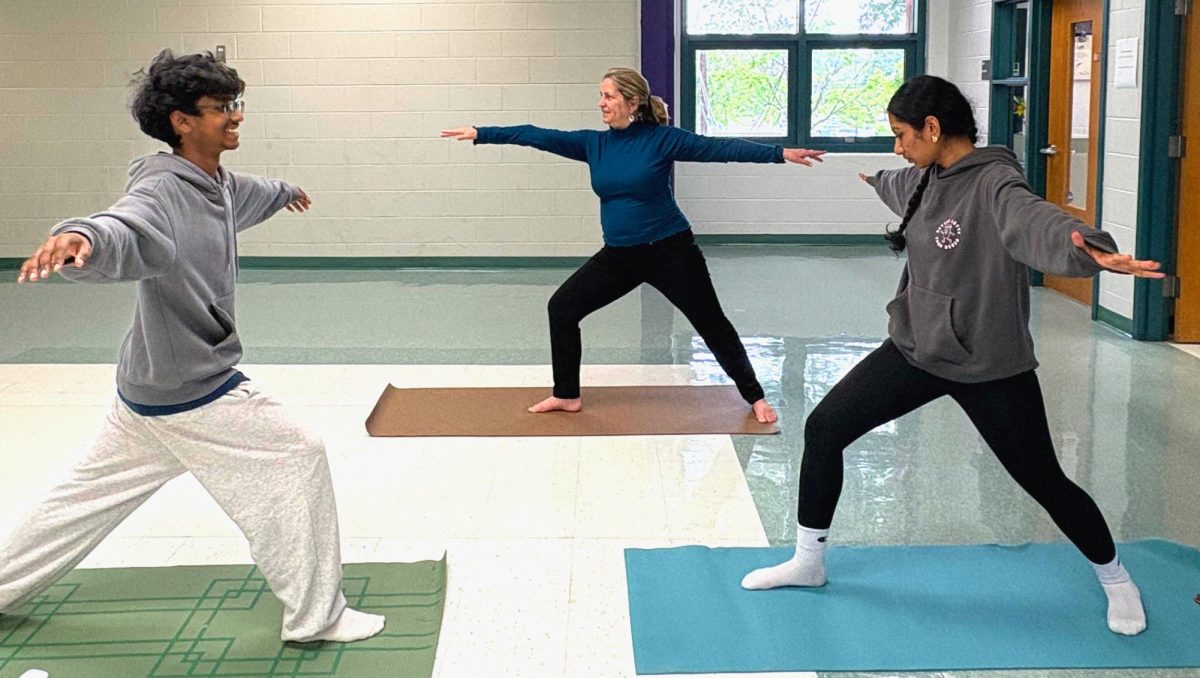
Junior Bhavyasri Chaluvadi rolls out a mat, takes a breath and begins stretching. There’s no rushing or heavy lifting, just slow, steady movement. For Chaluvadi, that steady pace is what makes yoga appealing, offering a way to stay active without the pressure of intense workouts.
Yoga is an ancient practice that originated in Indian philosophy. As stated by the National Center for Complementary and Integrative Health, yoga began as a spiritual practice rooted in traditions focused on the mind and body. Over time, it has developed into different styles, often emphasizing physical postures, breathing techniques and meditation.
“I chose yoga as my fitness approach because it’s a balance between physical and mental,” Chaluvadi said. “Most workouts, like cardio or weightlifting, only focus on strength or cardio, but yoga has vast categories of what you can work on.”
As stated by Everyday Health, yoga includes a variety of styles, such as restorative, hatha (slow-paced) and vinyasa (links breath to movement), each requiring different levels of movement and physical exertion. The difference between a restorative class with very little movement and a fast-paced class is that individuals move more quickly through poses. Due to this range, yoga can be included in a fitness routine to help meet a wide variety of physical activity goals depending on the type and intensity practiced.
“Yoga can be a good alternative for people who don’t enjoy high intensity workouts because you can modify the different exercises to your level of comfort,” junior Leah Masten said.
According to the National Library of Medicine, yoga’s physical benefits are largely associated with asanas (physical postures). These exercises can improve flexibility, strength and coordination. While results vary, regular practice of asanas may support overall physical functioning and contribute to improved body awareness. Chuluvadi uses yoga to build strength, flexibility and balance.
“So some of the benefits I get from yoga are improved flexibility, a stronger core and better posture,” Chuluvadi said. “It leaves me feeling more energized and I also like to run on a daily basis, so when I want a rest day I can still be active by doing yoga instead.”
The mental benefits of yoga are often linked to practices such as pranayama (practice of controlling breath) and meditation. These techniques may help calm the mind, reduce stress and increase awareness.
“I had developed the interest in mindfulness around the same time I got back into yoga,” school social worker Susan Daly said. “I noticed that I’m happier, I’m calmer, I’m kinder, I have a better awareness of myself. Yoga has been known to benefit people with depression and anxiety, and it has benefited me with reducing feelings of anxiety.”
Daly sponsors CHS’ yoga club, where students come together to practice yoga in a structured group setting. The club explores different styles of yoga, which can range from gentle, low-movement sessions to more active ones. They meet every Thursday from 3-3:45 at room 803 and welcome anyone who would like to join. After the school day, students can use yoga as a way to step away from schoolwork and reset their focus.
“There’s someone in particular who comes in like that,” Daly said. “If we run out of time or if she’s getting picked up early, [she would ask], ‘Can we just do that relaxing part? It helps me relax and quiet my mind.’”