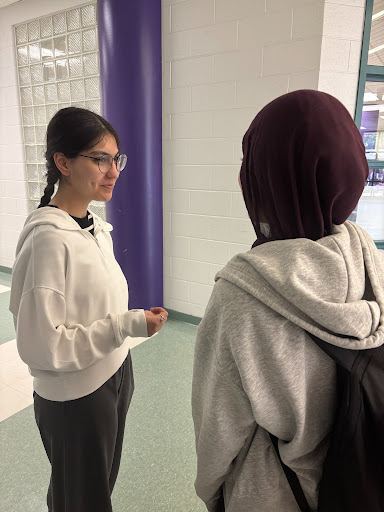


“Merhaba, nǐhǎo, kamusta, annyeonghaseyo, salam.” These greetings echo through CHS, where students bring languages from around the world into the hallways. While language learning often begins in classrooms, for many, it starts at home, shaping identity, connection and understanding of the world.
Established in 1957, National Foreign Language Week was created by Alpha Mu Gamma to encourage more students to study other languages in school. In 2009, it expanded into National Learn a Foreign Language Month, now celebrated each December. People mark the month by spending time with others who speak fluently, teaching someone a language, taking a sign language class or picking up a book about a language.
At CHS, 1,662 out of 3,017 students speak a language at home that is not English. In total, students report speaking 67 different home languages.
Students can study additional languages from elementary through high school in FCPS. Elementary programs like Foreign Language in the Elementary Schools (FLES) and Dual Language Immersion (DLI) introduce languages such as Chinese, Spanish, French and Arabic through weekly instruction. High schools also offer courses from beginner to Advanced Placement (AP) levels in multiple languages.
“I went to Oak Hill Elementary School and there they teach Chinese as the [main] language instead of Spanish,” freshman Betul Keskin, whose home language is Turkish, said. “Ever since I started at [Oak Hill Elementary] school, I started to like [Chinese] a lot and my parents started taking me to lessons.”
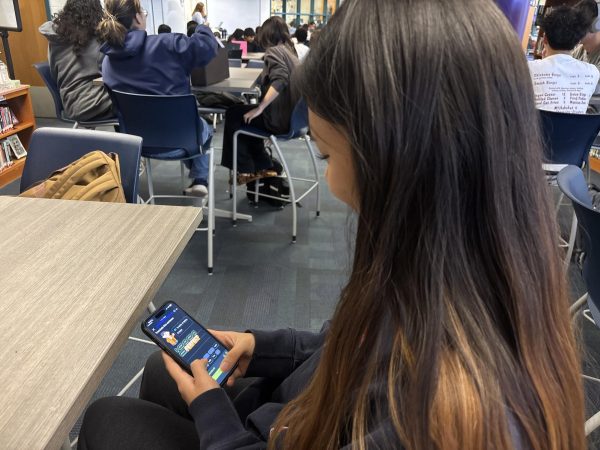
(Munevver Culha)
The American Council on the Teaching of Foreign Language (ACTFL) reports that languages are beneficial for building deeper connections with people, sharpening decision making, developing a better memory and expanding perspectives.
“Learning or knowing another language would definitely help with being able to understand the country’s culture since a lot of the culture is embedded in the language,” sophomore Ileana Jarelosa, who learned Tagalog and Hiligaynon at home, and Chinese and Korean at school, said.
According to Cambridge University Press & Assessment, studying a language improves memorization skills, like learning new words and rules, as well as recall. Research from the National Library of Medicine (NLM) shows that people who speak a second language regularly perform better on memory tests than those who are monolingual.
“For English, I do have some trouble saying certain words, but my memory in Kurdish is a lot stronger than in English because I [grew up] with it,” senior Imran Abdulhadi, who learned Kurdish (Kurmanji) at home, said.
According to ACTFL, children who have studied an additional language are more likely to demonstrate higher levels of empathy and tolerance. Language learning deepens and expands the way people move through the world.
“There is definitely a part of me where I empathize more with foreign people in America because I know how they struggle with English and how learning English would be hard for them since they speak another language,” Jarelosa said.
Knowing another language expands perspectives by fostering a deeper understanding of different cultures. NLM states that this allows individuals to see the world from multiple viewpoints, leading to more nuanced communication, reduced stereotypes and the ability to connect with a wider range of people.
“I feel like knowing a language and what they’re saying about their own region of land on the news is important to their perspective but also everyone else’s,” Abdulhadi said. “If you don’t know what they’re saying, then it’s just harder to know what’s going on around that area.”
As stated by St. Augustine College at Lewis University, bilingual individuals are often better communicators because they navigate different linguistic and cultural contexts, which sharpens their ability to interpret nuances and express themselves.
“I can meet more people, communicate with others and I feel like if there is ever a scenario for somebody who didn’t speak a certain language, I can try communicating with them,” Keskin said.
Learning a new language can happen through conversations with friends or family, listening to music, watching shows, using apps or joining clubs. Each method can help students connect with different cultures and see the world in new ways.
“I think learning from other people is crucial,” Abdulhadi said. “Everyone learns differently, and sometimes hearing things in your own language helps you understand better.