

Whether “For Good” or bad, the sequel film adaptation of “Wicked” leaves a lasting impact on its audience. After 21 years on the stage, the story reaches global audiences in a new light, illustrating the fine line between good and evil.
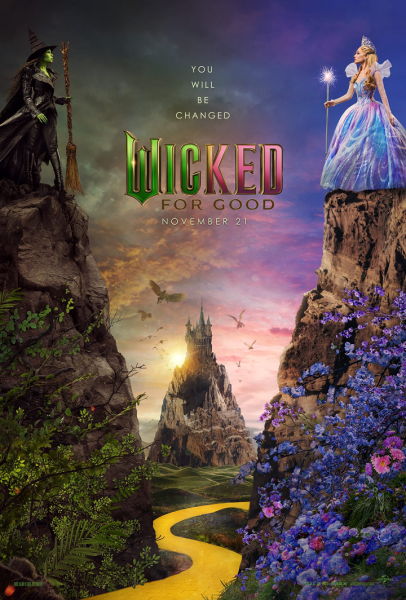
“Wicked: For Good” is a stage-to-screen adaptation of the second act of the Broadway musical “Wicked,” which itself is adapted from Gregory Maguire’s 1995 novel “Wicked.” Altogether, the stories are all based on L. Frank Baum’s 1900 novel “The Wonderful Wizard of Oz” and its 1939 film adaptation. The story takes place in the Land of Oz, following two young women named Elphaba, who was born with emerald-green skin, and Galinda, a bubbly, popular girl. With music and lyrics by Stephen Schwartz, a screenplay by Winnie Holzman and direction from Jon M. Chu, the audience explores the pair’s journey in becoming the Wicked Witch of the West and Glinda the Good Witch.
Cynthia Erivo as Elphaba and Ariana Grande as Glinda undoubtedly steal the show with powerful vocal and emotional performances through solo and duet songs such as “Thank Goodness / Couldn’t Be Happier,” “No Good Deed” and “For Good.” The two create a remarkably moving relationship between their characters, in both their friendly and antagonistic moments, as the story navigates through the chaotic events of the original film “The Wizard of Oz.”
In particular, Ethan Slater stands out in his portrayal of Boq as the character turns vengeful, epitomized by his strong presence in the song “March of the Witch Hunters” and strengthened by an incredible ensemble. Additionally, Jonathan Bailey’s musical presence as Fiyero is not outstanding, with just a small role in “Thank Goodness” and a duet with Elphaba in “As Long As You’re Mine.” However, his acting compensates through one of the most climactic scenes of the film on the Yellow Brick Road, perfectly expressing his character’s desperation and inner conflict.
This film also introduces two new songs that are not in the Broadway musical. “No Place Like Home” includes Elphaba trying to convince a group of animals not to flee from Oz, referencing Dorothy’s declaration in the 1939 film. Erivo’s soulful tone paired with pensive lyrics explore a sociopolitical commentary on loving a homeland that oppresses one’s people, resonating with the themes of “Wicked” and making this track a worthy fit for the musical. On the other hand, while vocally impressive, Grande’s performance of “The Girl in the Bubble” is unnecessary to understand Glinda’s emotional shift at this part of the story, seeming inorganic, as if written to increase the film’s runtime.
Additionally, “Wicked: For Good” makes several divergences from an average stage production of “Wicked” that damage the film overall. While casting choices of already-famed performers such as Grande or Slater turned out to be rewarding, Jeff Goldblum as the Wizard and Michelle Yeoh as Madame Morrible lower the quality of the film with sub-par vocal performances and somewhat shallow portrayals of their respective characters, especially in comparison to previous musical theater legends in these roles such as Joel Grey and Carole Shelley, who were a part of the original Broadway cast. Furthermore, Marissa Bode’s Nessarose does well to illustrate the darker side of the character, but falls flat with a weak vocal and acting performance of her most important and revealing song, “The Wicked Witch of the East,” failing to provide a compelling emotional depth.
Although a movie musical should make subtle changes from the stage musical, the delivery of certain lines in the film was disappointing compared to the typical theatrical acting found in the Broadway show. For one, there was the removal of Elphaba’s prolonged shout of Fiyero’s name, overlapping with Glinda’s shriek, at the beginning of “No Good Deed.” Moreover, Erivo’s delivery of her line expressing how Elphaba feels “wicked” at the end of “As Long As You’re Mine” felt passive rather than impassioned, and the excessive Ozian sayings, such as a “clock tick” rather than a “second,” felt odd and unnatural, disrupting the immersiveness of multiple scenes.
The 2024 film “Wicked” presented the first act of the Broadway musical, the epitome of a wonderful, almost-flawless adaptation. Ensemble and solo performances peaked with “No One Mourns the Wicked,” “What Is This Feeling?” and “The Wizard and I.” In comparison, this sequel falls short in many of these aspects.
However, the final minutes of the film serve as a redemption with the astonishing performances of Erivo and Grande in the culminating track “For Good,” an emotional farewell between their characters and acknowledgment of their complicated friendship. The actors achieve an exceptional, praiseworthy depiction of the reconciliation. The development of the relationship between Elphaba and Glinda makes the bittersweet ending and the bringing of the story full circle and more gratifying.
By the end of the film, the main cast and ensemble certainly prove themselves as expert theatrical performers with remarkable musical displays and emotional performances, but acting weaknesses from less prominent characters and changes made from the original musical highlight the film’s glaring insufficiency to perform as a perfect adaptation for fans of “Wicked.” However, with the tagline “you will be changed for good,” this film ultimately fulfills its promise for the general audience.