
It is 4 a.m. on Feb. 17, the first day of Ramadan. Now, Muslims around the world prepare to fast from sunrise to sunset for the next 30 days, a tradition of nearly 1,400 years.
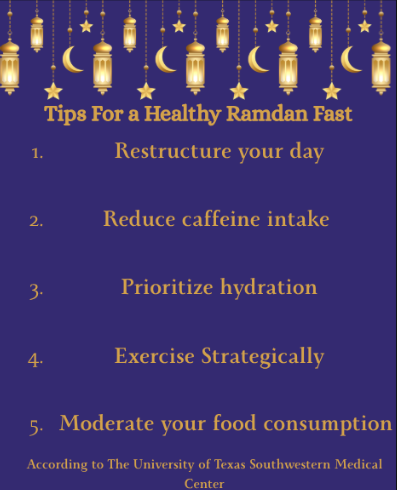
According to Islamic Relief Worldwide, Ramadan will start on Feb. 17 and end on March 20, with official dates varying depending on moon sightings in the holy city of Mecca. From sunrise to sunset, Muslims in good health refrain from consuming anything during the day. Muslims must fast because sawm, which means fasting, is one of the five pillars of Islam. During the time when muslims fast it is encouraged to increase daily worship by increasing focus on holy texts and maintaining good character by engaging in acts of kindness. In addition to this, Ramadan is also a time to reflect on actions throughout the year. Muslims often attempt to refrain and reflect on forbidden acts that they are around. They also take Ramadan as time to get closer to god by participating in holy actions.
“The whole purpose of it is so you can get better astronomically,” senior Rakan Ali said. “You can start new habits and everything.”
To prepare for the daily fast, Muslims have suhoor, the pre-dawn eating before the first prayer of the day. The fasting is sunnah, one of the rules the Islamic prophets followed, when Muslims eat suhoor, as they believe it can bring spiritual blessings. Many eat food higher in nutritional value and nourishment that will provide energy throughout the day, including foods full of protein and liters of water.
“I eat a lot of protein like eggs and dates,” freshman Meera Hamed said. “I try to bulk up on food so I won’t be hungry later on in the day.”
Throughout the day, Muslims await Iftar, the time when the fast is broken, to eat food. During Iftar, traditional foods such as samosas, a pastry with a meat filling, are often eaten by families like junior Dania Osman’s.

“On Fridays, I gather with a bunch of my family and friends at a big location and we eat iftar together,” Osman said. “A lot of times, it’s people from my country and we just hang out and have fun.”
After Muslims eat, they head to the mosque to pray taraweeh, the sunnah prayers performed by Muslims during Ramadan nights. During the last ten days of Ramadan, called Laylatul Qadar, Muslims who are able to pray Qiyam participate as it continues through the night.
“I’d say the last ten days you really want to go all out [in contrast to] normal months,” Ali said. “The reward [after] feels much better.”
Additionally, at the mosques, there will often be announcements for people to donate. Muslims are encouraged to donate as it is part of zakat, another one of the five pillars of Islam.
“Whenever we go to any taraweeh prayer, they make an announcement for donations,” Osman said. “My parents try to at least donate some money during that time.”
The holiday of Eid al-Fitr marks the end of the month of Ramadan. During the day, Muslims traditionally go to Eid salah, meaning prayer and gather to celebrate together. According to Osman, she often talks with her fellow Muslim friends about how they spent their Ramadan and what they had learned from fasting throughout the month.
“After Ramadan, I reflect on how well I did on my performance,” Osman said. “Not just on no food and no drinks but on how well I performed as a person.”