As college admissions become increasingly competitive, one question continues to spark debate: whether or not standardized tests should be required. With growing concerns about fairness, predictive value and the rise of artificial intelligence (AI), educators and students should rethink the role these exams play.
A peer-reviewed summary of over 70 empirical studies found that, while standardized tests are statistically reliable, the validity of the decisions derived using SAT and ACT scores especially for students from racial minority and socioeconomically disadvantaged backgrounds is at issue when these tests are used to make high stake decisions. This suggests that relying heavily on these exams may not be the fairest or most accurate way to evaluate students’ potential.
Standardized testing has long reflected disparities in income and access to educational resources. Research from UC Berkeley shows that students from higher-income families score significantly higher on exams such as the SAT and ACT. According to Fairtest.org, these score gaps are closely tied to family income, parental education levels and access to preparation resources. Wealthier students are more likely to afford multiple test attempts, costly preparation courses and private tutoring, advantages that can result in even small score increases that meaningfully affect admissions decisions at competitive institutions.
Although research from Pennsylvania State University suggests that test preparation alone may not dramatically raise scores, access to repeated test opportunities and strong academic support systems still provides an advantage for students with greater financial resources. When performance on a single exam is closely connected to family income and educational privilege, requiring that exam risks reinforcing existing socioeconomic inequalities rather than measuring true academic potential.
Beyond issues of fairness, standardized tests are limited in their ability to predict long-term college success. Research published through the National Institutes of Health found that SAT and ACT scores are most strongly correlated with first-year college GPA, but less are effective at predicting long-term outcomes such as graduation rates or graduate school enrollment. Similarly, analysis from the Fordham Institute concluded that while standardized tests provide some predictive value, high school GPA often remains a stronger and more consistent indicator of overall college performance.
This research suggests that academic consistency over four years may provide a more accurate picture of student readiness than a single standardized exam score.
On the other hand, with the rapid rise of AI, some argue that standardized tests are more important than ever. Students cannot use AI to cheat on in-person standardized tests because they are strictly supervised and evaluated under consistent criteria. AI makes it increasingly difficult to ensure the authenticity of homework and essays, making standardized exams one of the only assessment tools immune to AI interference. This concern has led some colleges to reconsider test-optional policies, fearing that AI-generated application essays make it harder to assess genuine student ability.
While these concerns about AI are valid, making standardized tests mandatory is not the best solution. Standardized exams measure performance under timed, high-pressure conditions, which may not reflect a student’s true abilities or long-term potential. Additionally, according to the National Association for College Admission Counseling (NACAC), many colleges use holistic review processes that consider interviews, writing samples, academic records, extracurricular activities and personal context alongside or instead of standardized test scores. These alternative evaluation methods allow institutions to assess students more comprehensively without relying solely on high stakes exams. Requiring standardized tests for all students as a response to AI concerns may overcorrect the problem and place unnecessary stress on applicants.
The reliance on standardized testing in the United States has shifted significantly since the COVID-19 pandemic. According to Georgetown University, many colleges temporarily dropped test requirements in 2020 and 2021 when testing disruptions made it difficult

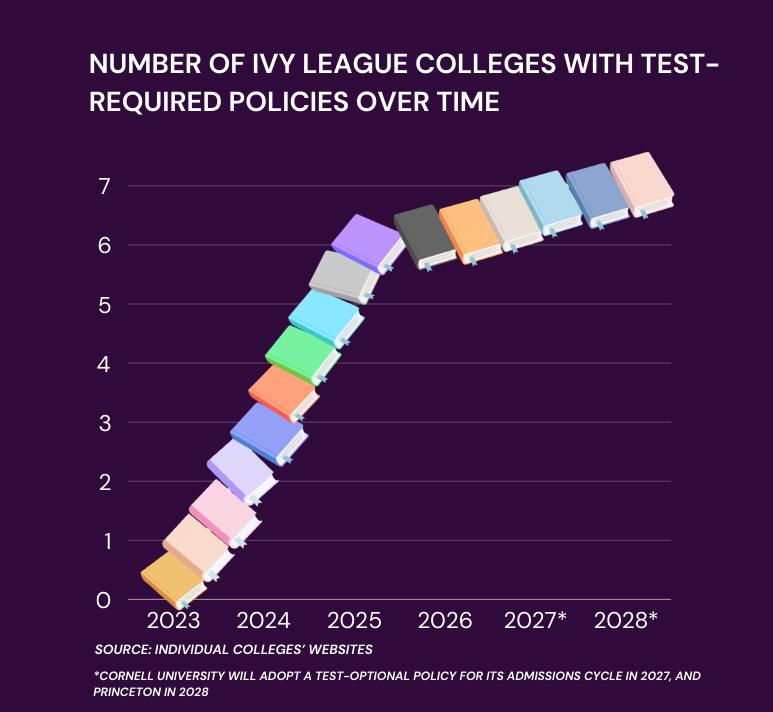
for students to sit for the SAT or ACT. However, in recent years, a number of selective universities have reinstated testing requirements, especially at highly-ranked schools. According to Princeton University, several Ivy League institutions such as Harvard, Brown and Dartmouth now require SAT or ACT scores again after previously going test-optional, and Princeton plans to do the same beginning with the 2027 admissions cycle, leaving only a few elite holdouts like Columbia with test-optional policies.
More than 400 colleges in the United States including liberal arts colleges, regional public universities, and some nationally ranked institutions already do not require SAT or ACT scores, according to Fairtest.org, the National Center for Fair and Open Testing. Research examining more than 120,000 students at test-optional colleges has found little difference in college GPA and graduation rates between students who submitted standardized test scores and those who did not, suggesting that schools can evaluate students successfully without mandatory exams. These variations show that standardized testing remains a debated and in a way evolving part of American university admissions, rather than a one-size-fits-all requirement.
Ultimately, standardized tests should remain available for students who believe their scores strengthen their applications. However, they should not be required for everyone. GPA, course rigor, extracurricular involvement, leadership and personal experiences offer a more complete and long-term picture of a student’s readiness for college. Making standardized tests optional promotes fairness, reduces unnecessary pressure and acknowledges that a single number cannot define a student’s potential. Colleges should continue moving toward holistic admissions processes that evaluate students as individuals, not just as test scores.