

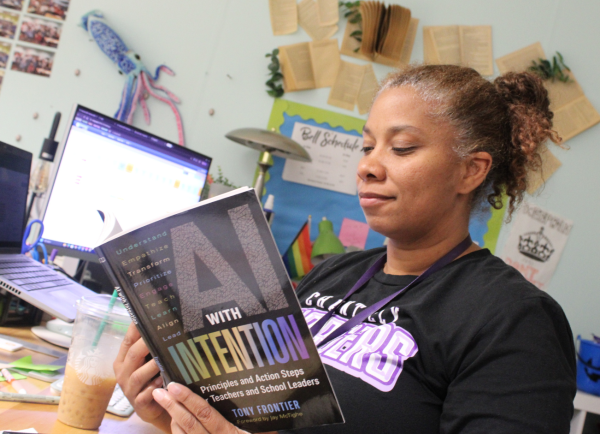
School districts across the country, including FCPS, have partnered with OpenAI, giving almost 150,000 educators access to ChatGPT for Teachers. While chatbots assist teachers with their responsibilities, in many cases, educators punish students for their use of such technology.
(Leilah Ross)
Having AI accessible to educators creates tension between staff and students as the question of whether teachers will abuse that privilege comes to mind. When teachers use AI for their work, it may help make tasks less overwhelming for them, but while telling students it goes against academic integrity when they do it, causes students to lose respect for their educators.
FCPS superintendent Dr. Michelle Reid claimed that by partnering with OpenAI, she wanted ChatGPT to guide teachers and staff through things such as interactions that involve communication and translating languages, preparing to teach and getting data processed. These tools can be useful as it could further help teachers reach students, but it shouldn’t be overused as teachers may abuse the tool and find ways around it to benefit themselves.
If educators continue their use of AI, they can end up developing a dependence on the systems. According to MIT Sloan, people can form a dependency on AI through the pressure to be the best in society which creates a need to stand out, leading to people using AI to mimic human thinking in order to come out on top while using less mental energy.
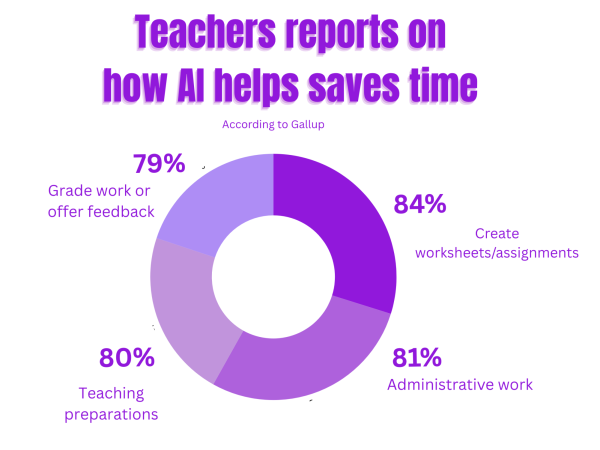 AI has expanded across the education system raising concern for societal function in the future. According to Education Week, the number of teachers that used AI in their work in 2023 was 34%, but increased in 2025 to 61%. The reliance on AI across the education system is detrimental to society’s independence, as too much usage can lead to a decrease in critical thinking and problem solving. These skills are crucial in life, and allowing AI to replace a person’s thought process will suppress brain development and maturity.
Students spend hours around teachers who end up serving as a role model to the students they teach. Educators using AI can cause students to see that as a representation of it being acceptable to cut corners, which could cause students’ drive to learn to decrease. According to Nalanda International School, students become motivated to learn through teachers who follow the same principles they expect in their classroom. When educators demand something they themselves don’t follow, it can impact students academically, making them see the teacher as unmotivated and feel less encouraged to learn the material organically.