

While candidates chase victory, debating over hard-hitting issues such as immigration and the cost of living, Virginia will, for the first time, experience a new kind of win: its first female governor.
Both candidates have a history of breaking barriers. Republican candidate Winsome Earle-Sears is the first female veteran, first naturalized citizen and first Black female Republican to serve in the Virginia House of Delegates. Democratic candidate Abigail Spanberger was the first and only woman to represent her district in the House of Representatives.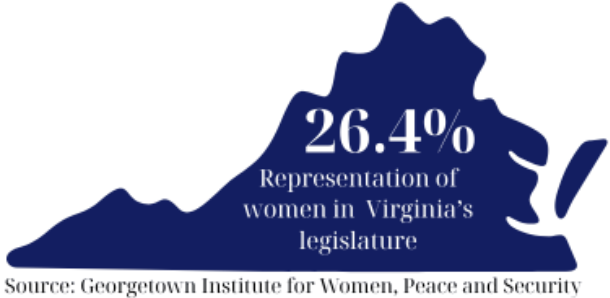
Diversity in government is not about meeting quotas or matching ratios. It’s about encouraging citizens to become more involved in their government. A study in The Journal of Politics found through redistricting that African American incumbents cause African American voters to vote more.
Whitney Quesenbery, Director of the Center for Civic Design, notes that those who are involved in their community and act for causes that they are passionate about sometimes don’t vote because they don’t “hear the echoes of their own voices in the election results.” Quesenbery advocates for the need to “invite every community” to vote, not simply give them the ability to do so: something that can be achieved if a candidate belongs to their community or shares their demographics, further highlighting the importance of the state government representing a diverse set of people.
With both candidates bringing representation to groups that have historically been underrepresented in politics, Virginia’s upcoming election can do just that. At the state level, only about 30% of legislators are women, reflecting a broader need for female representation in Virginia’s government. Spanberger’s win of Virginia’s seventh district by a margin of over 70% gave it its first female representative in Congress; representing her district in the House of Representatives, she became a strong advocate for women’s reproductive rights.
Earle-Sears brings important representation not just to the government, but to her party. In recent years, Black politicians tend to be Democratic, with only five of 67 current Black members of Congress being Republican.
Once in office, the impact that female governors can have isn’t restricted to representation, either; in fact, they may actually lead differently. According to a study from Zhejiang University, female governors tend to use more communal language and prioritize cooperation, resulting in female governors turning their policy proposals into law more than their male peers. During the COVID-19 pandemic, female governors were quicker to issue stay-at-home orders and their states had fewer deaths early on, according to the Journal of Applied Psychology.
Over 420 thousand early ballots have already been cast as of Oct. 9 per the Virginia Public Access Project–a nearly twofold increase in votes compared to this point in the 2021 gubernatorial election. This is reflective of the voter engagement that these candidates have brought; more than a statistic or a way to “catch up” to other states with more female representation, the background of Virginia’s future governor will make more citizens feel empowered in their vote.


